You sit down to finish one small edit before a meeting. When you look at the clock, the meeting has already started. On another day, a routine task takes much longer than you expected, leaving no time to get ready for what comes next.
People often call experiences like these ADHD time blindness. The phrase describes difficulty noticing time passing or estimating how long something will take. It is an informal description rather than a separate medical diagnosis, and it is not unique to ADHD. [1]
A visible timer or a well-timed reminder can give you an external reference. The useful question is which part of the situation needs support: getting started, keeping track while you work, or moving on.
Time awareness can vary
ADHD can involve difficulty directing attention, organising activities and managing time. It does not mean that every person experiences the same problem in every setting. [2]
A 2023 review of adult ADHD research found a small and varied evidence base on time perception. Some studies found differences in estimating or reproducing time intervals; others did not find a clear difference. The methods also varied. That supports a careful conclusion: time difficulties are relevant for some adults with ADHD, but no single description fits everyone. [3]
If losing track of time is a problem for you, start by observing one recurring situation. Perhaps leaving for an appointment is difficult, while following a familiar work routine is easier. Build support around the specific transition.
Choose the tool for the job
Different time tools answer different questions:
- A reminder brings back an action at a chosen date and time, such as “Save my work and open the meeting link.”
- A timer counts a duration after you start it, such as ten minutes to sort a small pile of paperwork.
- A countdown shows the time remaining until a chosen date and time, such as a planned departure.
In nagping, you can open Timers, Countdowns or Reminders directly. A countdown has an optional finish alert and cannot be snoozed. Choose a reminder when you need an action you can snooze or reschedule. [4]
Seeing a countdown and receiving an alert serve different purposes. Keep the display where you can glance at it, and decide what you will do when the chosen time arrives.
Plan the transition before the appointment
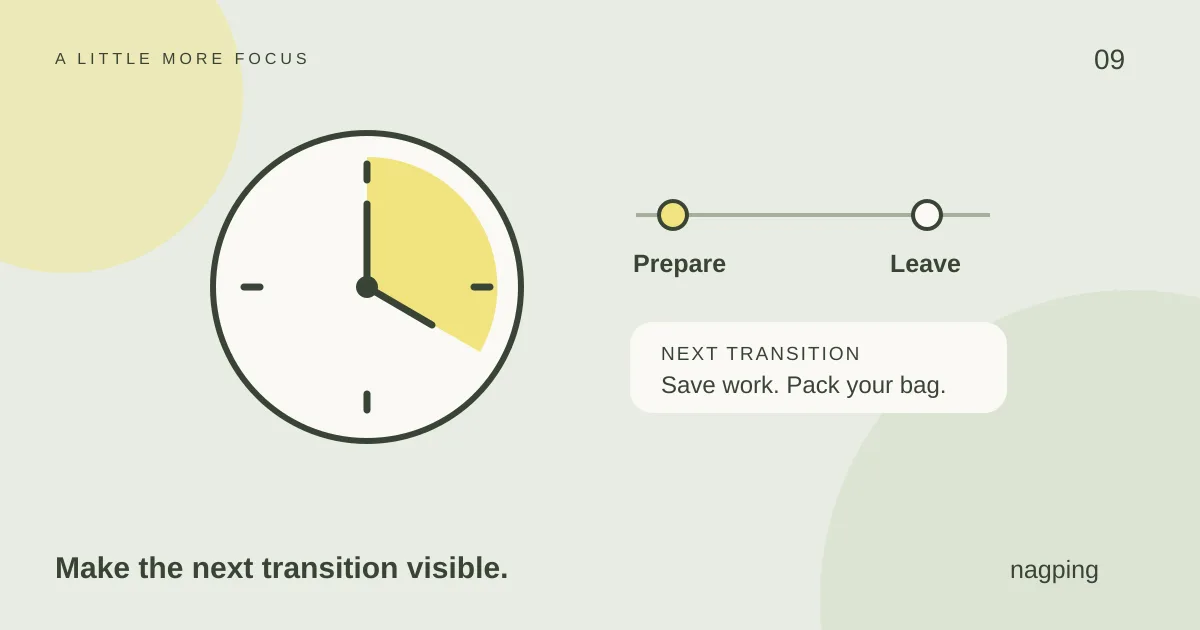
Imagine you need to leave home at 4 pm. A reminder at 4 pm may arrive before you have packed your bag or put on your shoes.
Try separating preparation from departure:
- Work out the time you need to leave, including your own travel margin.
- List what must happen before leaving, such as saving work, packing a document and finding your keys.
- Set a preparation reminder early enough to do those steps.
- Add a separate departure reminder if another cue would be useful.
These are reminders you set deliberately; nagping does not automatically calculate your preparation or travel time.
UCI Health suggests recording how long activities actually take and leaving space between them. You can apply that idea by noting how long your preparation took on a few occasions, then adjusting the next reminder. The margin should reflect your circumstances rather than an arbitrary rule. [5]
Give a work session a clear stopping point
If an open-ended task is hard to pace, try a short session with a defined aim. “Spend ten minutes collecting the figures for the report” is easier to assess than “Work on the report.” Ten minutes is an example to experiment with, not a prescribed ADHD attention span.
Nagping’s Focus view offers Timebox, Pomodoro, Custom intervals and Open focus. Choose a mode that suits the activity. A session with an endpoint may be useful when you want to practise stopping; an open session may suit a task where you prefer to watch elapsed time.
When the session ends, check what is left and decide whether to stop, take a break or schedule another session. NICE includes shorter periods of focus with movement breaks among possible environmental adjustments for ADHD. It does not prescribe one universal work-and-break interval. [6]
Notice whether the timer helps or distracts
Some people find a visible clock useful. Others find constant checking or frequent sounds distracting. Start with one time tool and notice its effect before adding more.
If the endpoint arrives while you are absorbed in work, leave a brief restart note before switching: “Next, check the total in the final row.” If the timer creates pressure, try a longer interval, fewer alerts or a different kind of external cue.
For an approaching commitment, preserve enough time to stop. Extending a session repeatedly can leave the next activity with the same rushed transition you were trying to avoid.
If the challenge is remembering an intention in the first place, our guide to ADHD forgetfulness and reminder routines explains how to write and time a useful cue.
Try one transition tomorrow
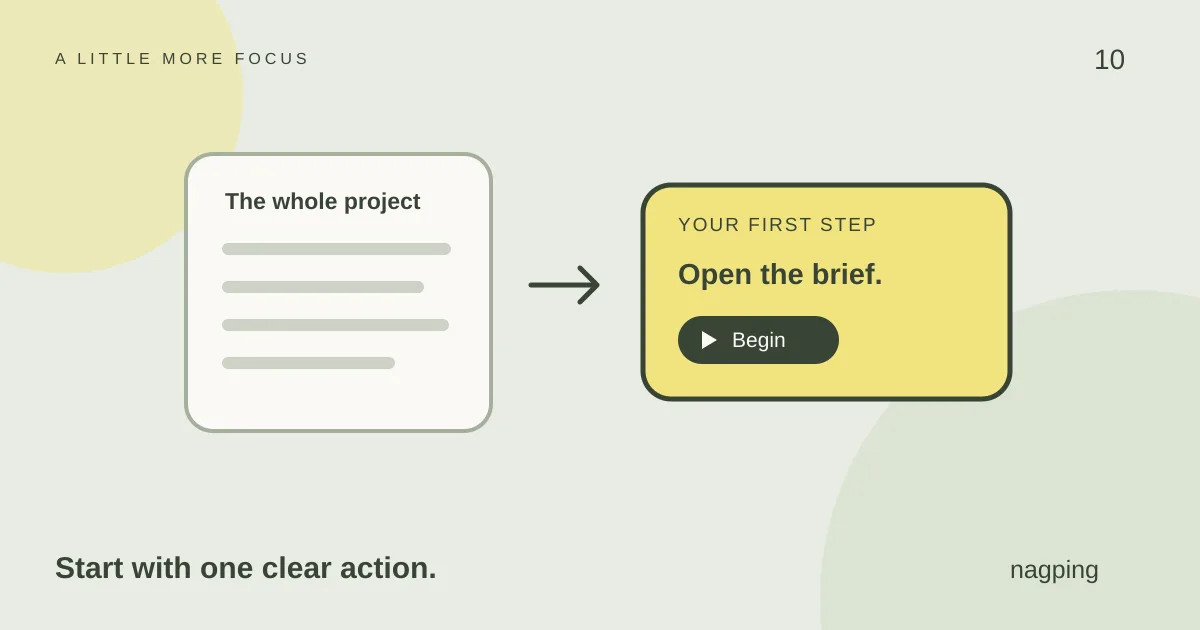
Choose a single point in your day, such as finishing a work session or preparing to leave. Set a timer or create a named reminder for that moment, then review whether the cue arrived early enough to be useful.
Nagping’s browser tools can be explored without signing in. Guest items stay in that browser. Keep the app open and the device awake for browser alerts, and check notification permissions; background restrictions can delay them. [4]
Timers are organisational aids, and the cited research does not demonstrate that nagping treats ADHD. If time difficulties repeatedly disrupt daily life, discuss them with a qualified healthcare professional so that practical tools can sit alongside appropriate support. [7]
Sources
- Cleveland Clinic: What Is Time Blindness and Why Does It Happen. 2 May 2023.
- National Institute of Mental Health: ADHD in Adults 4 Things to Know. 2024.
- Mette C: Time Perception in Adult ADHD Findings from a Decade A Review. 2023.
- nagping: Features and frequently asked questions. Product details checked 21 October 2026.
- UCI Health: Coping with time blindness and ADHD. 21 May 2024.
- NICE: Attention deficit hyperactivity disorder diagnosis and management NG87. Environmental modifications.
- NHS: ADHD in adults. Reviewed 19 March 2025.